Shock Index
The Shock Index compares heart rate to systolic blood pressure to help identify patients with compensated or occult shock.
Inputs
Result
Enter values to calculate
Formula
Shock Index = HR/SBPCalculator Diagram
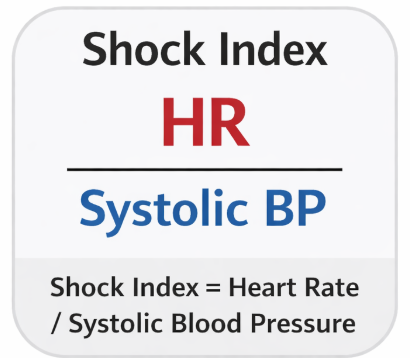
Shock index is calculated by dividing the heart rate by systolic blood pressure and is a useful indicator of early shock.
📚 Calculator References(1)
Theory and Practice
Shock Index: A useful hemodynamic parameter to identify occult shock
Hypotension is a late sign of shock, particularly in trauma, because compensatory vasoconstriction can preserve systolic blood pressure until physiologic reserve is exhausted. A large national trauma validation study supports this ATLS principle: normal blood pressure should not deter aggressive evaluation and resuscitation, because systemic hypotension appears late in the course of shock.[1]
At the same time, heart rate alone is an imprecise variable. Pain, anxiety, fever, hypoxia, beta-agonists, and atrial fibrillation can all drive tachycardia without true circulatory collapse. What clinicians need is a simple way to combine “rate” and “pressure” into one interpretable signal that can detect compensated shock and help quantify risk.
That’s the role of the Shock Index (SI).
What is Shock Index?
Shock Index (SI) = Heart Rate (HR) ÷ Systolic Blood Pressure (SBP)
SI was originally described in 1967 by Allgower and Burri and has since been validated across multiple acute care settings.[2][3]
Why shock index works (conceptually)
Early shock: HR rises and SBP may still look “normal” → SI increases even when SBP alone is reassuring.
Worsening shock: HR remains high (or rises further) and SBP starts to fall → SI climbs sharply.
SI is therefore a compact approximation of hemodynamic stress that can surface deterioration before overt hypotension. [3]
What’s a “normal” shock index in adults?
Most reviews cite a typical adult SI range around 0.5–0.7, with values near 1.0 signaling worsening hemodynamics. Intermediate values of >0.8 are associated with adverse outcomes in some populations, and the exact threshold to consider abnormal varies based on the population being studied. [3]
How to interpret SI at the bedside
A practical way to use SI is to consider implications for various thresholds (loosely):
SI < 0.7: generally reassuring (context-dependent)
SI 0.7–0.9: “watch closely” zone
SI ≥ 0.9: commonly used threshold for higher risk in trauma/bleeding
≥ 1.0: high-risk physiology across multiple conditions (often correlates with adverse outcomes)
Two additional principles matter as much as the number:
Trends beat single points. A rising SI is often more informative than a single snapshot.
Interpret in context. Beta-blockers, pacemakers, analgesia, sedation, and dysautonomia can blunt tachycardia (and mask SI elevation).
Shock Index Predictive Performance Across Clinical Contexts
Below is a summary of shock index performance across several populations.
1) Shock Index in Trauma
Trauma is the population where SI has been studied most extensively, and where it has been demonstrated that elevated SI is sensitive to occult hemorrhage even when SBP is still normal.
Key Literature
A systematic review and meta-analysis (12 studies; 348,687 trauma patients) found SI ≥ 1 was associated with roughly a four-fold increase in in-hospital mortality (pooled RR ~4.15). [4]
SI thresholds around 0.9–1.0 are widely used as flags for higher risk and potential need for hemorrhage-focused escalation (e.g., activating MTP, earlier blood product resuscitation). [5][3]
Practical takeaways
SI ≥ 0.9: meaningful increase in risk for massive transfusion and worse outcomes in trauma cohorts. [5]
SI ≥ 1.0: consistently high-risk physiology; treat it as a strong trigger to reassess bleeding, perfusion, and need for escalation of resuscitation. [4]
2) Shock index in Sepsis
In sepsis, SI is useful because it can identify patients who are compensating (tachycardic) before hypotension declares itself.
Screening and risk
In an ED cohort study, SI ≥ 0.7 was the most sensitive single screening test for hyperlactatemia (≥4 mmol/L) and 28-day mortality; SI ≥ 1.0 was the most specific for both outcomes. [6]
Why trending matters
In severe sepsis, a sustained SI elevation > 0.8 (for ≥80% of ED vital sign measurements) predicted significantly higher vasopressor requirement within 72 hours (38.6% vs 11.6%; adjusted OR ~4.42). [7]
Practical takeaways
Consider SI ≥ 0.7 as an early “don’t miss” threshold in suspected sepsis, especially when lactate is pending. [6]
Consider persistent SI > 0.8 as a trajectory warning sign, even if the first BP is “okay.” [7]
One pitfall for SI in sepsis
Unlike hemorrhagic shock were tachycardia is typically compensatory for low stroke volume to maintain cardiac output, in sepsis, tachycardia can be driven by systemic inflammation and endogenous and/or exogenous chronotropes. This may partially account for less adoption of SI in sepsis compared to trauma.
3) Shock index in Myocardial Infarction
In acute MI, SI can help identify patients at risk of or in early cardiogenic shock.
Key findings
In a cohort of 644 STEMI patients, SI ≥ 0.8 was associated with substantially higher in-hospital mortality (commonly cited as ~20% vs ~4% when SI <0.8). [8][9]
Enhancing performance
Age-adjusted variants (e.g., Age × SI) can outperform SI alone and approach the performance of more complex scores in some STEMI cohorts. [10]
Practical takeaways
SI ≥ 0.8 in STEMI should heighten concern for adverse outcomes and prompt aggressive monitoring for shock. [8][9]
4) Shock Index in Pulmonary Embolism (PE)
In acute PE, SI captures obstructive shock physiology (tachycardia + falling SBP) driven by RV failure.
Key findings
In 159 acute PE patients, SI ≥ 1 was associated with increased in-hospital mortality independent of echocardiographic findings. [11]
However, SI alone is not the best “low-risk rule-out.” In a large study comparing SI vs sPESI, sPESI identified fewer low-risk patients, but those classified low-risk by sPESI had a much lower 30-day mortality (about 1.6% vs 8.3% in “low-risk” by SI). [12]
Practical takeaways
SI ≥ 1 in PE is a high-risk signal, even without echo. [11]
If your goal is safe discharge/home treatment selection, pair physiology (SI) with a validated clinical score (e.g., sPESI). [12]
Pediatrics: Use SIPA (Not Adult SI)
Kids are different: normal HR and SBP vary by age, so adult SI thresholds don’t translate well.
SIPA = Shock Index, Pediatric Age-Adjusted
SIPA has been shown to be more accurate than hypotension alone for identifying pediatric trauma patients who need urgent intervention (operation, intubation, transfusion). [13]
A well-cited pediatric trauma cohort (559 children) found hypotension alone performed poorly, while SIPA improved identification of children needing urgent care escalation. [13]
Practical takeaways
Use SIPA tables/age bands rather than adult cutoffs.
As with adults, trend matters: persistent or rising SIPA is a red flag.
Clinical Implementation: How to Use Shock Index in clinical practice
1) Treat SI as an “early warning” flag
If SI is rising, ask: Is perfusion deteriorating? Is bleeding ongoing? Is RV failing? Is there worsening shock of any etiology?
2) Pair SI with what it’s best at
Trauma: bleeding risk / MTP consideration [4][5]
Sepsis: occult shock / escalation risk; watch trends [6][7]
PE / MI: hemodynamic compromise triage; don’t use SI alone as a discharge tool [11][12]
3) Integrate shock index with microcirculatory assessment
Shock index is a useful variable to detect 'macrohemodynamic' abnormalities, however, it does not identify patients with impaired circulation at the capillary level. Consider using capillary refill time, assessing for mottling, and other microcirculatory surrogates to help ensure your resuscitation improves both the macro and micro-hemodynamics.
For additional reading on how to integrate macro and micro-circulatory abnormalities, check out the Hemodynamic Interfaces Calculator.
References
- 1. Parks JK, et al. [Systemic hypotension is a late marker of shock after trauma](https://pubmed.ncbi.nlm.nih.gov/17161083/)
- 2. Mutschler M, et al. [The Shock Index revisited – a fast guide to transfusion requirement?](https://pmc.ncbi.nlm.nih.gov/articles/PMC4057268/)
- 3. Koch E, et al. [Shock index in the emergency department: utility and limitations](https://pmc.ncbi.nlm.nih.gov/articles/PMC6698590/)
- 4. Vang M, et al. [Shock index as a predictor for mortality in trauma patients: a systematic review and meta-analysis](https://pubmed.ncbi.nlm.nih.gov/35258641/)
- 5. Rau CS, et al. [Prediction of Massive Transfusion in Trauma Patients with Shock Index >0.9](https://www.mdpi.com/1660-4601/13/7/683)
- 6. Berger T, et al. [Shock Index and Early Recognition of Sepsis in the ED: Pilot Study](https://pmc.ncbi.nlm.nih.gov/articles/PMC3628475/)
- 7. Wira CR, et al. [The shock index as a predictor of vasopressor use in ED patients with severe sepsis](https://pmc.ncbi.nlm.nih.gov/articles/PMC3952891/)
- 8. Bilkova D, et al. [A Simple Clinical Parameter for Quick Mortality Risk Stratification in acute STEMI (644 patients)](https://www.sciencedirect.com/science/article/abs/pii/S0828282X11004442)
- 9. Supeł K, et al. [Shock index and TIMI risk index as prognostic tools](https://journals.plos.org/plosone/article?id=10.1371/journal.pone.0227374)
- 10. Zhou J, et al. [Age shock index and age-modified indices in STEMI undergoing PCI](https://pubmed.ncbi.nlm.nih.gov/31206405/)
- 11. Toosi MS, et al. [Prognostic value of shock index along with echocardiography in acute pulmonary embolism (159 patients)](https://pubmed.ncbi.nlm.nih.gov/18308025/)
- 12. Sam A, et al. [The shock index and the simplified PESI for identification of low-risk PE](https://pubmed.ncbi.nlm.nih.gov/20650994/)
- 13. Acker SN, et al. [Shock index, pediatric age-adjusted (SIPA) is more accurate than age-adjusted hypotension for trauma team activation (559 children)](https://pubmed.ncbi.nlm.nih.gov/27814956/)
Contributors

Dr. Ross Prager